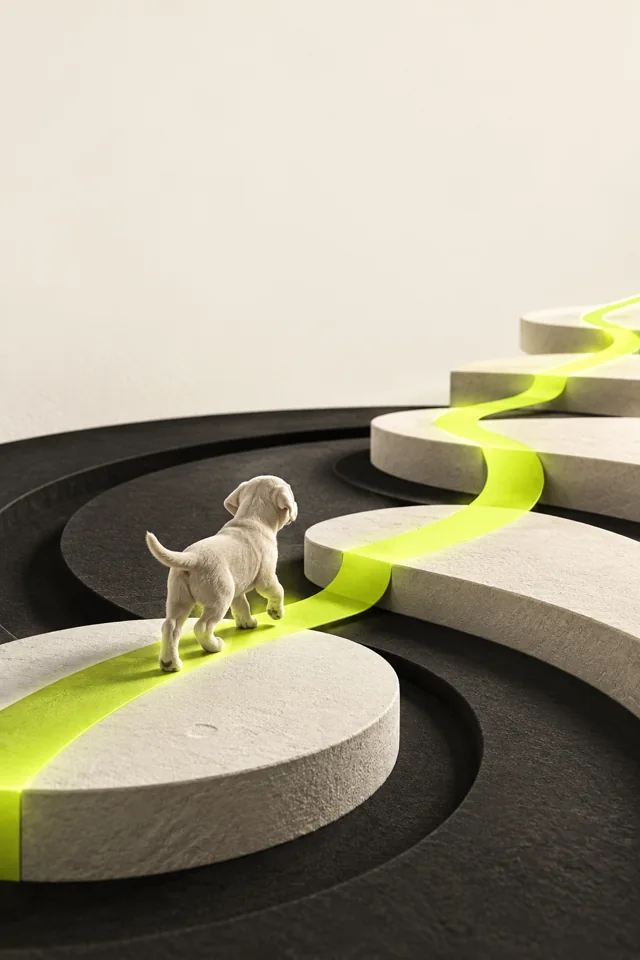
Puppy training / K9 ACADEMY
Puppy training: where to start in the first month
Your first month is not a race to collect commands. It is a time for safety, routine and shared communication. Here is how to organise toilet habits, attention, recall and first encounters.
Published 9 October 2026 · Practical guide
What is a realistic goal?
Many owners ask when their puppy should know every command. A more useful question is what will help them feel safe today. Rest, predictable toilet breaks and consistent human responses create the foundation for later skills.
Puppies adjust at different speeds. Avoid comparing progress with short social videos. Look for concrete changes: easier settling, voluntarily turning towards you and fewer mistakes with better organisation. Our puppy training page brings the main areas together.
Week one: organise the environment
Limit access to risky objects, provide water and create a rest area. Introduce the home gradually without passing the puppy from person to person. Children should understand that a sleeping puppy or one moving away needs space.
Record waking, meals, play and toilet needs. Offer breaks after these events and reward promptly. Clean accidents without punishment. Arrange help when you are away: a young puppy cannot simply fit an adult dog’s schedule.
K9 / LET’S TALK
Let’s talk about your dog.
Call us to discuss the right training for your dog. Explore our programmes
Week two: attention and coming back
Practise the name in a quiet room. Say it once, mark a turn towards you with “yes” and reward. Avoid repeating it constantly amid distractions. Reduce distance or change the environment if the task is too difficult.
For an early recall, crouch a short distance away in a secure area, use a friendly cue and reward the approach. Sometimes release your puppy back to play. Coming to you should not always end something enjoyable. Never call them over to punish them.
Week three: the lead and calm observation
Introduce a harness through brief, pleasant attempts. Reward approaching it and wearing it comfortably. Then practise a few loose-lead steps in a quiet, safe area.
Plan outings around your veterinarian’s guidance on health risks. Socialisation can include watching people or movement at a comfortable distance. Move away if your puppy becomes frightened. Avoid pushing them towards a trigger to make them get used to it.
Week four: transfer familiar skills
A skill in the kitchen is not automatically the same skill on a busy street. Try a familiar cue in another quiet room and reward easy successes. Start more simply in a new place.
Change one factor at a time: distance, duration or distraction. Return to an easier task after repeated difficulty. Explore our training process to build a consistent progression.
A brief practice sequence
- Choose a quiet area and prepare suitable small rewards.
- Try a few easy repetitions of the name.
- Invite your puppy to follow for two or three steps.
- Offer a calm activity or rest.
- Record what worked and what to simplify next time.
This is an example, not a compulsory programme for every puppy. Finish earlier if tiredness, tension or loss of interest appears. Include food rewards within a suitable daily intake discussed with your veterinarian.
When should you consult a trainer?
Support helps when household rules conflict, fear increases or daily organisation is difficult. There is no need to wait for a serious problem. Individual training begins with age, health, environment and goals.
Not every behaviour is a training issue. Pain, sudden changes, reduced appetite or other symptoms need veterinary assessment. For bite risk, create safe separation and seek professional support rather than experimenting at home.
Frequently asked questions
When does training begin?
Simple everyday habits can begin on arrival. The intensity and environment should suit age, health and adjustment.
How long should a session be?
Use brief sessions that finish while interest remains. Quality and calm are more useful guides than a rigid number of minutes.
How do we track progress?
Record one concrete goal, the conditions and the result. For structured tasks, explore K9 Academy’s digital guides.
Sources and further reading
General principles follow guidance from American Veterinary Society of Animal Behavior on reward-based training and safe socialisation. This educational material is not an individual assessment. Seek a veterinarian and qualified professional for pain, sudden changes or bite risk.